Understanding Charter Types in the Maritime World
What are the 3 types of charter in the maritime industry? Here’s the quick answer:
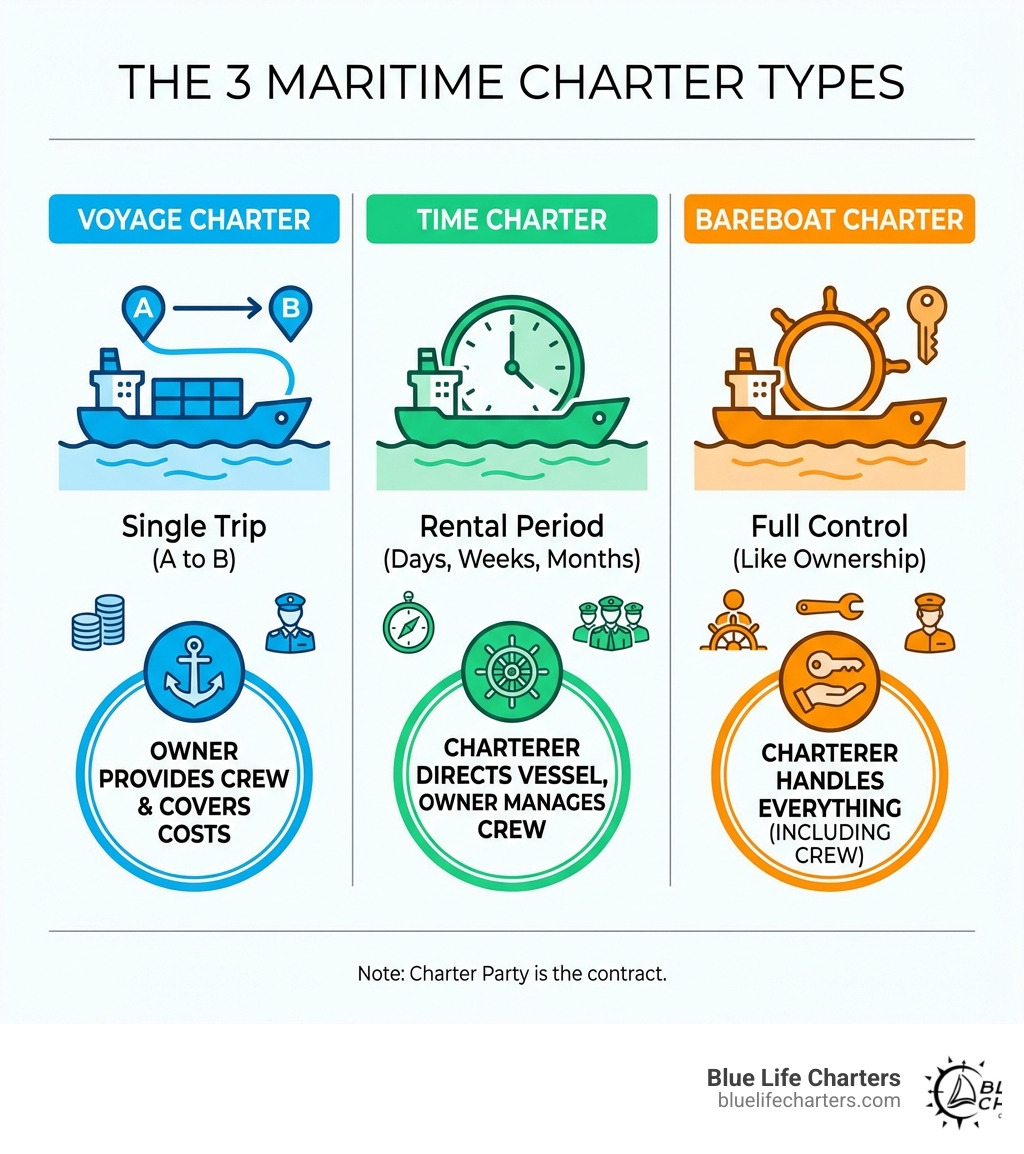
- Voyage Charter – Hiring a vessel for a specific trip from point A to point B, with the owner covering operating costs
- Time Charter – Renting a vessel for a set period (days, weeks, or months), with the charterer controlling its use but the owner managing the crew
- Demise (Bareboat) Charter – Taking full control of the vessel as if you own it, including hiring crew and covering all operational expenses
Whether you’re planning a one-time adventure or considering regular excursions on the water, understanding these charter types helps you make the right choice for your needs and budget.
In shipping, a charter is simply a contract between a vessel owner and someone who wants to use that vessel—called the charterer. The specific details are laid out in a formal agreement known as a charter party. While these terms originated in commercial shipping (think cargo ships and tankers), the same principles apply to recreational boating, from private yacht excursions to family sailing trips.
The main difference between charter types comes down to control, cost, and responsibility. In a voyage charter, you’re essentially buying transport for a specific trip. With a time charter, you’re renting the boat and crew for a period. And with a bareboat charter, you’re taking the helm yourself (or hiring your own crew) with complete operational control.
I’m Wit Morris, owner and lead captain of Blue Life Charters, and I’ve spent years helping clients steer the waters of South Carolina while understanding what are the 3 types of charter mean for their specific boating needs. My experience ranges from skippered day trips to bareboat arrangements, giving me insight into how each charter type serves different goals and preferences.
The Core Answer: What Are the 3 Types of Charter in Boating?
When you decide to venture out onto the beautiful waters around Charleston and Folly Beach, you’ll encounter different ways to arrange your boat trip. These arrangements, or charters, are essentially agreements that define who does what, who pays for what, and who’s in charge. Understanding these distinctions is key to a smooth sailing experience. Let’s explore the three main types.
Type 1: The Voyage Charter
Imagine you need to get a specific cargo from one point to another, or perhaps you just want a vessel for a single, unique excursion. That’s where the voyage charter comes in.
A voyage charter is an agreement where a vessel is hired for a specific journey or a round-trip between defined ports. It’s often used for one-off shipments or occasional requirements in commercial shipping, but its principles can be seen in one-time recreational trips too, like a special event cruise from Charleston Harbor to a specific destination. The contract concludes once the specific voyage is completed and the cargo is discharged (or the passengers disstart at their final destination).
Here’s how it typically works:
- Definition: We lease out our vessel and crew for a single trip from a loading port to a discharge port. The focus is on the completion of the specific journey.
- Agreed Rate & Payment: The cost for a voyage charter is usually a lump sum or based on the quantity of cargo being transported. For our private boat tours, this would be a set price for a defined trip, like a specific sightseeing route or a trip to a particular island.
- Owner Responsibilities: As the shipowner (or charter company, in our case), we retain full responsibility for operating the vessel. This includes providing the crew, handling all maintenance, ensuring the vessel is insured, and covering fuel costs and port costs. You, as the charterer, are primarily responsible for the cargo itself, or simply enjoying the journey if it’s a recreational trip.
- Key Terms:
- Laytime: This is the agreed-upon period for loading and unloading cargo. While more relevant in commercial shipping, it highlights the importance of efficient operations.
- Demurrage: If laytime is exceeded, the charterer pays a penalty called demurrage. Think of it as a late fee for holding up the vessel.
- Despatch: Conversely, if the charterer finishes loading/unloading early, they might receive a payment from the owner called despatch, an incentive for efficiency.
Advantages for the charterer (you!):
- Simplicity: You pay a single freight rate or lump sum, and we handle all the operational complexities.
- No Operational Hassle: We take care of the vessel, crew, fuel, and port logistics. You just show up and enjoy your journey.
- Flexibility for One-Off Needs: Perfect for a unique event, a special tour, or a specific destination without long-term commitment.
Disadvantages for the charterer:
- Less Control: You have limited control over the vessel’s schedule or route once the voyage is agreed upon.
- Market Fluctuations: The freight rate can fluctuate with market conditions, though for recreational charters, our prices are typically fixed.
A voyage charter is ideal for those seeking a straightforward, one-time transport solution or a planned excursion where all the operational details are handled for them. For more in-depth information on voyage charters, you can refer to maritime resources like Maritimeknowhow website: voyage charter.
Type 2: The Time Charter
Sometimes, a single trip isn’t enough. You might need a vessel for a longer duration, with the flexibility to decide where and when it goes. This is where the time charter shines.
A time charter is an agreement to hire a vessel and its crew for a specified period, which can range from a few days to several months or even years. During this time, you, the charterer, have significant control over the vessel’s commercial operations, deciding its schedule, routes, and cargo (or recreational activities!).
Here’s what defines a time charter:
- Definition: We lease our vessel and crew to you for a fixed period. We manage the technical operation of the boat (crew, maintenance, insurance), but you direct its commercial use.
- Hire Rate: Payment is typically a fixed amount per day, known as the “hire rate.”
- Charterer Responsibilities: You cover the variable costs associated with the voyage itself. This includes fuel costs, port charges (like docking fees in Charleston), canal tolls, and cargo handling costs. You also dictate the vessel’s commercial use, choosing the ports and routes.
- Owner Responsibilities: We remain responsible for the vessel’s maintenance, seaworthiness, and providing a qualified crew. We handle the “fixed costs” of owning and operating the boat.
- Operational Control: This is a key differentiator. You choose the destination, the speed, and the overall itinerary. This is perfect for custom multi-day tours around the Charleston area or extended exploration of the Lowcountry.
- Off-Hire Clause: Time charters often include an “off-hire” clause. This means that if the vessel is unable to perform its duties (e.g., due to mechanical breakdown or necessary repairs), the hire payments might be suspended for that period. This protects you from paying for a non-functional vessel.
Advantages for the charterer:
- Predictability and Control: You get to plan your itinerary, route, and schedule, offering great flexibility for your adventures around Charleston.
- Operational Freedom: You decide where we go and what we do within the agreed-upon period, making it ideal for customized experiences.
- Cost Management: While you pay for fuel and port fees, the daily hire rate provides some financial certainty for the duration of your trip.
Disadvantages for the charterer:
- Shared Responsibility: While we handle the vessel’s technical side, you’re responsible for many operational costs and decisions, requiring more active involvement.
- Less Flexibility if Plans Change: If your plans change drastically, you’re still committed to the agreed-upon time period.
A time charter is an excellent choice for those who want to explore the waters of Charleston and Folly Beach for an extended period, with the freedom to craft their own adventure while leaving the vessel’s technical management to us. For a look at our private boat tours that can be custom for a set time, visit our page on Private Boat Tours Charleston SC for Every Occasion.
Type 3: The Demise (or Bareboat) Charter
For those who truly want to be the captain of their own destiny, a demise charter offers the ultimate level of control and responsibility.
A demise charter, often referred to as a bareboat charter, is a unique arrangement where you, the charterer, take full possession and operational control of the vessel. It’s as if you’ve borrowed our boat and are treating it as your own for the duration of the agreement. The name “bareboat” comes from the idea that the vessel is handed over “bare” – without a crew, provisions, or fuel.
Here’s what makes a bareboat charter distinct:
- Definition: We provide the vessel, and you take full responsibility for its operation, crewing, maintenance, and all associated costs.
- Full Control: You get complete command of the vessel, just as if you owned it. This means you hire the crew (if needed), manage maintenance, arrange insurance, and cover all running costs.
- Legal and Financial Responsibility: All legal and financial obligations related to the vessel during the charter period fall squarely on your shoulders. This includes liability, ensuring compliance with regulations, and managing all expenses.
- Crewing: Unlike voyage or time charters where we provide the crew, in a bareboat charter, you are responsible for providing your own qualified crew, or operating the vessel yourself if you are suitably licensed and experienced.
- Duration: These charters can be short-term, such as a week-long sailing adventure around the Lowcountry, or long-term, sometimes spanning many years, resembling a hire-purchase agreement where the charterer might eventually acquire ownership.
- Owner’s Responsibility: Our responsibility as the owner is limited to providing a seaworthy vessel at the outset and covering its capital cost (the cost of building it).
Advantages for the charterer:
- Maximum Freedom: You have absolute control over every aspect of your voyage – who’s on board, where you go, what you do, and how the boat is maintained.
- Cost Efficiency (for long-term use): For extended periods, a bareboat charter can be more cost-effective than repeatedly booking time charters, especially if you have your own crew and maintenance capabilities.
- “Ownership” Experience: It offers the closest experience to owning a vessel without the long-term commitment of purchase.
Disadvantages for the charterer:
- High Responsibility: You bear all the operational, legal, and financial risks. This requires significant maritime experience and knowledge.
- Significant Costs: You pay for everything – fuel, crew salaries, provisions, maintenance, insurance, and port fees.
- Expertise Required: This type of charter is best suited for experienced mariners who are comfortable managing a vessel and its crew independently.
A bareboat charter is an exciting option for experienced sailors and boaters who desire complete autonomy and are prepared to handle all responsibilities. If you’re ready to take the helm on your next Charleston adventure, explore our Bareboat Charter options.
Voyage vs. Time vs. Bareboat: A Head-to-Head Comparison
To help you visualize the differences and decide which type of charter best suits your needs, here’s a handy comparison table. We’ve distilled the key features of each charter type to provide a quick reference.
| Feature | Voyage Charter | Time Charter | Bareboat Charter |
|---|---|---|---|
| Definition | Vessel hired for a specific journey | Vessel hired for a specified period | Vessel leased without crew or provisions |
| Control | Owner controls operations, charterer cargo | Charterer directs commercial use, owner technical | Charterer has full operational control |
| Cost Structure | Lump sum or per-ton freight rate | Daily “hire rate” | All operational costs paid by charterer |
| Operating Costs | Owner pays fuel, crew, port fees | Charterer pays fuel, port fees; Owner pays fixed | Charterer pays all (fuel, crew, maintenance, etc.) |
| Crew Responsibility | Provided by owner | Provided by owner | Provided by charterer (or self) |
| Duration | Single trip, one-off | Fixed period (days, weeks, months, years) | Fixed period (weeks, months, years) |
| Best For | Specific, one-time transport or excursions | Regular transport, flexible itineraries | Maximum autonomy, experienced mariners |
| Risk Management | Owner bears navigation risks; Charterer cargo | Shared risks (owner technical, charterer operational) | Charterer bears almost all risks |
| Operational Flexibility | Low (fixed route) | High (charterer sets route/schedule) | Highest (complete freedom) |
This comparison makes it clear that the choice among the 3 types of charter depends heavily on your desired level of control, your willingness to manage operational details, and your budget for your time on the water in Charleston or Folly Beach.
From Commercial Rigs to Recreational Sailing: Applying Charter Concepts
While the terms “voyage,” “time,” and “bareboat” charters originated in the busy world of commercial shipping, carrying everything from oil to iron ore, their core principles are beautifully adaptable to the more serene (or exhilarating!) field of recreational boating. At Blue Life Charters, we bring these professional standards to your personal adventures on the water.
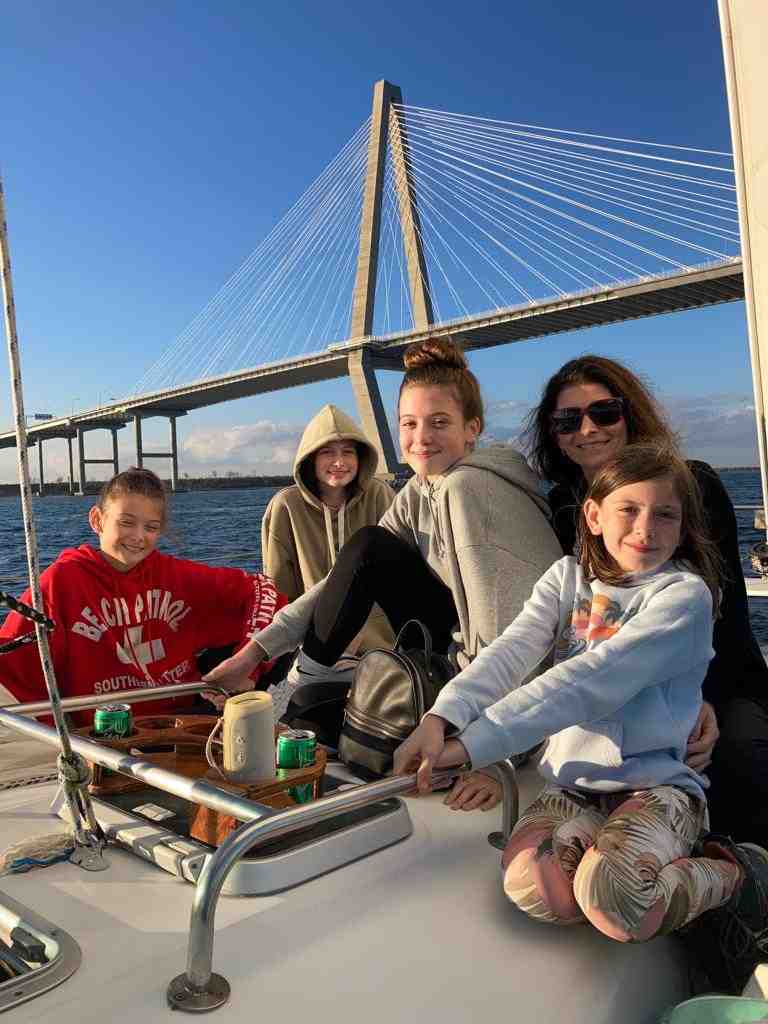
When you think about a family enjoying a private sailboat charter in Charleston, you might not immediately connect it to a massive container ship. However, the underlying contractual agreements share a common lineage. Our private charters, whether it’s a romantic sunset cruise or an adventurous day sail, draw on these established concepts to ensure clarity and satisfaction.
Recreational chartering covers a broad spectrum, from a few hours of sightseeing to multi-day excursions. We often offer skippered charters, where an expert captain (like our own skilled team) steers the vessel, allowing you to relax and enjoy the scenery. A crewed charter takes this a step further, including additional crew members like a chef or steward, providing an even more luxurious, hands-free experience.
We pride ourselves on offering award-winning experiences, where our expert captains ensure exceptional service. Whether you’re exploring the historic waterways of Charleston or finding a secluded spot off Folly Beach, we tailor our services to your dreams. For more insights into planning your perfect trip, check out our guide on Private Boat Charter in Charleston: Everything You Need to Know.
How do the 3 types of charter apply to recreational boating?
Let’s simplify how these commercial terms translate into your leisure time on the water:
-
Voyage Charter in Recreation: This is akin to booking a specific tour or excursion with a set itinerary. Think of our themed cruises, like a dolphin-watching tour or a historical harbor tour. You pay a set price for a defined journey, and we handle the boat, the captain, and the route. You simply show up and enjoy the ride. It’s a one-off, all-inclusive experience focused on the destination or activity.
-
Time Charter in Recreation: This is our most popular offering for those who want more flexibility. When you book a private boat tour for a set number of hours or days, you’re essentially entering a time charter. We provide the boat and a professional captain, and you get to decide the itinerary. Want to spend an extra hour at a secluded beach near Folly Beach? Or explore more of the Charleston Harbor? You have that commercial control over the vessel’s use during your booked time, while we manage the boat’s operation. It’s about renting the experience for a duration, with us taking care of the technicalities.
-
Bareboat Charter in Recreation (DIY Sailing): This is for the truly adventurous and qualified sailors among us! A recreational bareboat charter means you rent the sailboat “bare”—without a captain or crew. You are responsible for navigating, sailing, and all aspects of the boat’s operation. This requires a strong sailing background and appropriate certifications. It’s the ultimate freedom for experienced individuals who want to explore Charleston’s waters on their own terms. If you’re a seasoned sailor looking for this kind of independence, our Sailboat Charter Charleston SC options might be just what you’re looking for.
Key Factors When Choosing Your Charter
Deciding between these options for your Charleston or Folly Beach adventure isn’t just about understanding the definitions; it’s about matching the charter type to your personal preferences and needs. Here are some factors we encourage you to consider:
- Vacation Type: Are you looking for a completely hands-off, luxurious experience? A skippered or crewed time charter might be perfect. Do you crave the thrill of commanding your own vessel? A bareboat charter awaits.
- Trip Frequency: If it’s a one-time special event, a voyage-style charter (like a fixed private tour) is ideal. For regular excursions or longer stays, a time charter offers more flexibility.
- Cost Predictability: Voyage charters and fixed-duration time charters offer clear upfront pricing. Bareboat charters, while potentially cheaper per day for long durations, come with variable costs like fuel and provisions that you manage.
- Risk Tolerance: How comfortable are you with unforeseen challenges? On our skippered charters, we handle the risks. With a bareboat, you take on more responsibility.
- Experience Level: Do you have the necessary licensing and experience to operate a vessel safely? If not, a skippered charter is the wise (and often required) choice.
- Privacy and Control: How much say do you want in the daily itinerary? Bareboat offers maximum control, while our time charters provide excellent flexibility with a professional captain.
Choosing the right charter is like choosing the right outfit for the day – it needs to fit the occasion perfectly. We’re here to help you steer these choices, ensuring your time on the water is nothing short of spectacular. For more tips on making the most of your yacht experience, explore our Yacht Charter Etiquette Guide.
Frequently Asked Questions
We often get asked about the ins and outs of chartering. Here are answers to some common questions that go beyond just defining what are the 3 types of charter.
What is a charter party agreement?
At its heart, a charter party agreement is the legal contract between the vessel owner (us!) and the charterer (you!). This document outlines all the terms and conditions of the charter. Think of it as the blueprint for your journey, ensuring everyone is on the same page.
These agreements are crucial because they cover everything from the duration and cost of the charter to the responsibilities of each party, payment schedules, and what happens in case of unforeseen circumstances. They often use standard forms, especially in commercial shipping, but are always custom to the specific needs of the charter. For recreational charters, our agreements are designed to be clear, concise, and protect both your interests and ours. A shipbroker (or our charter company directly) plays a vital role in negotiating and finalizing these terms, ensuring a fair and legally sound arrangement.
What are laytime and demurrage?
While these terms are more prevalent in commercial voyage charters involving cargo, understanding them gives you a deeper appreciation for the logistics of maritime operations.
- Laytime: This refers to the agreed-upon period that a charterer has to load or unload cargo at a port. It’s a critical component of a voyage charter agreement, ensuring efficiency.
- Demurrage: If the charterer exceeds the stipulated laytime, they incur a penalty known as demurrage. This is essentially a fine paid to the vessel owner for delaying the ship.
- Despatch: On the flip side, if the charterer manages to complete loading or unloading before the allotted laytime, the owner might pay them despatch. It’s a nice little bonus for being efficient!
For our recreational charters, you won’t encounter laytime or demurrage. Our focus is on providing enjoyable, flexible experiences, not on strict loading schedules. However, it’s a fun piece of maritime trivia that highlights the precision required in the commercial world!
Beyond what are the 3 types of charter, what other agreements exist?
The world of maritime agreements is vast and can sometimes feel as deep as the ocean itself! While the voyage, time, and demise charters are the foundational 3 types of charter, there are several variations and related agreements that cater to specific needs:
- Contract of Affreightment (COA): This is an agreement where a vessel owner agrees to transport a specific quantity of goods over a particular route within a specified period, often involving multiple voyages. Unlike a traditional voyage charter, a COA doesn’t necessarily tie the charterer to a single vessel or a fixed laytime, offering more flexibility.
- Trip Time Charter: This is a hybrid that combines elements of both time and voyage charters. While it’s structured as a time charter (paid per day), its purpose is to cover a specific voyage route for a particular cargo. So, you get the commercial control of a time charter, but for a defined “trip.”
- Consecutive Voyages: This is a clause often included in a voyage charter where the same vessel performs multiple, sequential voyages for the same charterer. It’s like booking a series of voyage charters back-to-back.
These variations show just how adaptable chartering agreements can be, evolving to meet the diverse and dynamic needs of both commercial shipping and, by extension, the specialized recreational charters we offer in Charleston and Folly Beach.
Conclusion: Charting Your Course with the Right Agreement
Understanding what are the 3 types of charter—voyage, time, and demise (bareboat)—is more than just knowing maritime jargon; it’s about empowering you to make informed decisions for your adventures on the water. Each type offers a distinct balance of control, cost, and responsibility, designed to meet different needs, from one-off excursions to long-term nautical independence.
Whether you’re entrusting us with a fully crewed private tour (akin to a time charter for leisure), or you’re an experienced sailor ready to command your own vessel on a bareboat adventure, we at Blue Life Charters are here to guide you. We believe that choosing the right agreement is the first step towards perfect financial planning and open uping unforgettable adventures on the stunning waterways of Charleston and Folly Beach.
We are dedicated to providing exceptional service and making your time on the water seamless and spectacular. So, tell us, which type of charter will set sail with you on your next unforgettable journey?
Ready to explore the freedom of the open water? Explore our Bareboat Charter options in Charleston and find the perfect way to chart your course.