Demise charter vs bareboat: Crucial Guide 2024
Understanding Charter Agreements: Why It Matters for Your Next Adventure
Demise charter vs bareboat is one of the most confusing topics in maritime leasing, yet understanding the distinction is crucial for anyone planning a private yacht experience or considering vessel leasing options. Here’s what you need to know:
Quick Answer:
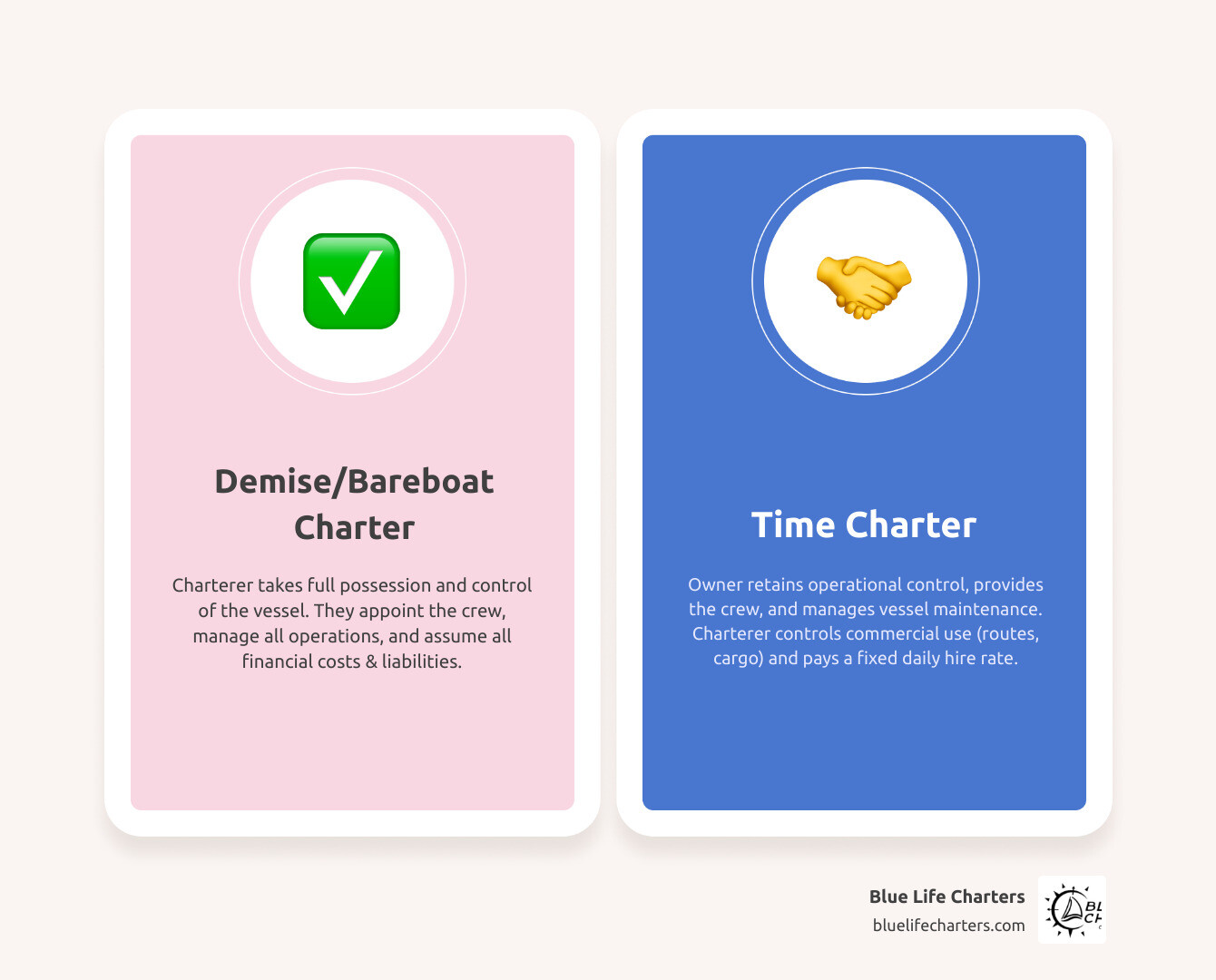
- Demise Charter = A lease agreement where the vessel owner transfers full possession and control of the vessel to the charterer, who must hire their own crew and handle all operations.
- Bareboat Charter = A specific type of demise charter where the vessel is leased “bare” (without crew, provisions, or equipment), and the charterer provides everything.
- Key Point: The terms are often used interchangeably in practice, both referring to the same concept: the charterer takes complete operational control and responsibility.
The research makes this clear: “As a basic proposition, the key element of a demise charter is that the charterer must have possession and control of the vessel along with the right to appoint the crew (and Master).” This transfer of control is what sets these charters apart from other types like time charters or captained charters, where the owner retains operational management.
Why does this matter for your luxury charter experience? If you’re planning a private yacht outing, understanding these terms helps you know exactly what level of control and responsibility you’re taking on—whether you want a fully crewed, worry-free experience or prefer the autonomy of commanding your own vessel.
I’m Wit Morris, owner and lead captain of Blue Life Charters, and I’ve spent years navigating the nuances of maritime charter agreements, including the critical differences in demise charter vs bareboat arrangements. My experience operating custom private charters has given me insight into how these legal distinctions translate to real-world boating experiences.
Explaining the Terminology: What Are Demise and Bareboat Charters?
When we talk about chartering a vessel, we’re essentially discussing a special kind of vessel leasing contract—a formal agreement known as a “charterparty.” These agreements are fundamental to maritime law and dictate the terms under which a vessel is hired. At the heart of the demise charter vs bareboat discussion is the crucial concept of “possession and control.” Unlike simply renting a car, chartering a vessel, especially under a demise or bareboat agreement, involves a significant transfer of operational authority.
The history of chartering stretches back through centuries, with formal practices evolving from ancient maritime trade. From Roman law’s locatio conductio rei navis to the mercantile practices of medieval European republics like Genoa and Venice, the concept of leasing a vessel has always been about facilitating trade and exploration. While modern charter agreements are far more detailed, they build on this long-standing tradition of defining who controls the ship and who bears the responsibilities. You can dig deeper into this rich history by exploring A Brief History of Chartering.
The Demise Charter: A Transfer of Possession
At its core, a demise charter is a legal agreement where the vessel owner leases their vessel to a charterer for a specified period. The defining characteristic, as legal definitions highlight, is that “the whole use and management of the vessel passes to the charterer.” This is a profound transfer of authority, making the charterer, for all practical purposes, the “disponent owner” of the vessel.
Under a demise charter, the charterer assumes a wide array of legal responsibilities that typically rest with the owner. This includes the freedom—and obligation—to appoint their own master and crew, manage all aspects of the vessel’s operations, and handle its maintenance. The charterer steps into the owner’s shoes for the duration of the contract, bearing the operational risks and liabilities. The U.S. legal framework, such as U.S. legal definitions, reinforces this, outlining the extensive control and responsibilities transferred to the charterer.
Contractual elements in a demise charter are meticulous, covering everything from the agreed duration and the vessel’s condition at delivery to the hire rate structure, maintenance obligations, and termination provisions. It’s a comprehensive legal document designed to clearly delineate the rights and duties of both parties, ensuring that the charterer has the autonomy needed to operate the vessel as if it were their own.
The Bareboat Charter: The “Bare” Essentials
Now, let’s talk about the bareboat charter. While the terms “demise charter” and “bareboat charter” are frequently used interchangeably in common parlance and even in some legal contexts, it’s helpful to understand their subtle distinction. A bareboat charter is, in fact, a specific type of demise charter. The key difference implied by “bare” is that the vessel is leased without any crew, fuel, or provisions.
This means that under a bareboat charter, the charterer is responsible for providing absolutely everything required to operate the vessel. This includes hiring licensed crew members (or acting as the captain themselves if qualified), supplying all fuel, provisioning the vessel, and managing all ongoing maintenance and repairs. It truly is a “bare” vessel, awaiting the charterer to bring it to life.
Bareboat charters are incredibly common in both recreational yachting and commercial shipping. For commercial entities, it offers a way to expand fleet capacity without the capital expenditure of purchasing a vessel. For recreational sailors in places like Charleston, SC, it provides the ultimate freedom to explore our beautiful waterways, charting their own course and enjoying privacy with their chosen companions. The popularity of bareboat charters in recreational sailing soared in the 2000s, driven by a desire for autonomy and flexible travel.
The Core Differences: Demise Charter vs Bareboat in Practice
While the terms demise charter vs bareboat might seem interchangeable, understanding the practical implications of each is key to making an informed decision. The transfer of possession and control fundamentally alters operational dynamics, financial responsibilities, and legal liabilities for both parties. It’s not just about signing a piece of paper; it’s about fully embracing the role of the vessel’s operator.
Whether you’re engaging in a commercial venture or planning a private expedition from Charleston, SC, these distinctions will shape your entire experience. Let’s break down where the rubber meets the road.
Control, Crew, and Command
The most significant aspect of a demise or bareboat charter is the absolute transfer of operational control. The charterer gains the authority to manage the vessel as if it were their own. This means we, as the charterer, have the right to appoint the Master (captain) and hire the entire crew. We direct all operational aspects, from setting the itinerary and navigation decisions to managing daily routines.
For us at Blue Life Charters, when we consider a bareboat arrangement for certain operations, this level of control means we can ensure our experienced, U.S. Coast Guard-licensed captains are at the helm, maintaining the highest safety standards and providing the local knowledge our clients expect. The owner, in turn, steps back almost entirely, with minimal involvement in the day-to-day operations once the vessel is delivered. This complete operational autonomy is a hallmark of the bareboat experience.
Cost and Responsibility Breakdown
When entering into a demise or bareboat charter, the financial responsibilities shift dramatically from the owner to the charterer. The charterer takes on virtually all the operational expenses (OPEX). This is a crucial distinction from other charter types, as it impacts budgeting and financial planning significantly.
Here’s a simplified breakdown of who typically pays for what under a bareboat/demise charter compared to a time charter:
| Responsibility | Demise/Bareboat Charter (Charterer) | Time Charter (Owner/Charterer) |
|---|---|---|
| Crew Wages & Provisions | Charterer (hires and pays all crew, supplies food/drink) | Owner (provides fully crewed vessel) |
| Fuel Costs (Bunkers) | Charterer | Charterer (for commercial voyages); Owner (often included in recreational captained charters) |
| Maintenance & Repairs | Charterer (day-to-day and often major repairs, within contract terms) | Owner (ensures seaworthiness, handles major repairs); Charterer (minor operational upkeep) |
| Insurance | Charterer (obtains hull, P&I, war risks) | Owner (provides hull, P&I); Charterer (may have cargo insurance) |
| Port Charges | Charterer | Charterer |
| Operational Control | Charterer (full control, acts as disponent owner) | Owner (operational control); Charterer (commercial control – routes, cargo) |
| Vessel Depreciation | Owner | Owner |
As you can see, under a bareboat charter, we assume comprehensive financial oversight. This includes crew wages, maintenance and provisions, lube, oil and water, bunkers (fuel), port charges, and any claims against the ship for loss or damage. Even all overhead expenses fall to the charterer. The owner is typically compensated through a fixed hire payment, often based on the vessel’s deadweight per calendar month, and is primarily responsible for the vessel’s depreciation. This extensive list of responsibilities underscores why meticulous financial planning is vital for bareboat charterers.
Legal and Financial Implications
Beyond the operational costs, the legal and financial implications of a demise or bareboat charter are substantial. For accounting purposes, these charters are often treated as a form of finance lease under international standards like IFRS 16 and US accounting standards (ASC 842). This means that the charterer, as the lessee, must recognize a “right-of-use” asset and a corresponding lease liability on their balance sheet, impacting financial ratios and reporting.
From a legal standpoint, the charterer assumes nearly all operational risks and liabilities. This includes responsibility for maintenance, crew management, and any potential third-party claims. Adequate insurance coverage is not just a good idea; it’s essential. The charterer is typically required to obtain comprehensive insurance, including hull and machinery, Protection & Indemnity (P&I) for third-party liabilities, and sometimes even war risks, depending on the operational area. This extensive liability transfer minimizes the owner’s risk once the vessel has been delivered in seaworthy condition.
Expanding the Fleet: How Do Demise Charters Compare to Other Types?
Understanding the nuances of demise charter vs bareboat is just one piece of the puzzle. The maritime world offers a spectrum of chartering options, each suited to different needs and levels of involvement. Choosing the right agreement depends entirely on your specific objectives, whether you’re a commercial entity seeking to optimize logistics or an individual planning a memorable vacation on the water.
We often help our clients in Charleston, SC, steer these choices, ensuring they select the option that best fits their desires for control, convenience, and cost. For a broader overview of the various agreements, you can find More info about the 3 types of charter.
Comparison with Time Charters
In a time charter, the relationship between owner and charterer is quite different from a demise or bareboat agreement. Here, the vessel owner retains possession of the ship, providing a fully crewed and operational vessel. We, as the charterer, essentially hire the vessel and its crew for a specific period (e.g., several months or years).
Our control in a time charter is primarily commercial: we decide the routes, the ports of call, and the cargo to be carried. However, the owner remains responsible for the vessel’s operational management, including crew wages, maintenance, and ensuring seaworthiness. Payment is typically a fixed daily hire rate, and agreements often include “off-hire” clauses, which specify periods (e.g., for repairs or unforeseen delays) when the charterer is not charged. While we direct the vessel’s movements, we don’t assume the profound operational responsibilities seen in a bareboat charter.
Comparison with Voyage Charters
Voyage charters represent another distinct type of agreement, fundamentally different from both demise and time charters. A voyage charter is an agreement for a single journey to transport a specific cargo between defined ports. The owner retains full operational control, providing the crew, fuel, and all necessary provisions for the voyage.
Payment in a voyage charter is usually based on a “freight rate,” either per ton of cargo carried or a lump sum for the entire journey. Key terms in voyage charters include “laytime” (the allowed time for loading and unloading cargo), “demurrage” (a penalty paid by the charterer if laytime is exceeded), and “despatch” (a bonus paid by the owner if operations are completed early). Voyage charters are ideal for one-off cargo transfers or when a company needs a vessel for a single, specific task, without any long-term commitment or operational involvement.
Comparison with Recreational Captained Charters
For many of our clients enjoying the beautiful waters around Charleston, SC, a recreational captained charter is the ideal choice. This is where Blue Life Charters truly shines, offering luxurious, stress-free experiences. In a captained charter, we provide a professional, U.S. Coast Guard-licensed captain and often a mate, who handle all aspects of maneuvering, safety, and navigation.
The main benefit here is relaxation and convenience. Our guests can simply sit back, enjoy the scenery, and let our expert crew manage the vessel. Our captains bring invaluable local knowledge, guiding you to the best spots for swimming, sightseeing, or simply enjoying a sunset cruise. This type of charter is perfect for those who want a pampered, all-inclusive service and are less interested in the operational responsibilities. It stands in stark contrast to a Bareboat Charter, where the charterer is the skipper. If you’re an inexperienced boater or simply want a worry-free day on the water, a captained charter is undoubtedly the best option.
Making the Right Choice for Your Voyage
Deciding between a demise, bareboat, time, or captained charter boils down to assessing your specific needs, experience, and the level of control you desire. Whether it’s a commercial strategy for fleet management or planning a perfect vacation in Charleston, SC, the choice profoundly impacts your responsibilities and experience.
When to Choose a Demise Charter: Commercial Applications
For commercial entities, a demise charter, often synonymous with a bareboat charter in this context, can be a strategic and flexible alternative to purchasing a vessel outright. It’s particularly appealing for:
- Long-term Fleet Expansion: Companies can expand their operational capacity for extended periods without the massive capital expenditure of buying a new ship. This is common for cargo carriers, tankers, and bulk carriers.
- Avoiding Capital Expenditure: Instead of tying up significant capital in vessel ownership, a demise charter allows a company to use a vessel through lease payments, preserving capital for other investments.
- Full Operational Control: Commercial charterers can implement their own operational strategies, manage their own crews, and optimize vessel use to meet their specific business objectives, such as in the offshore industry or for specialized project cargo. This full autonomy allows for seamless integration into their existing logistics and supply chains.
- Managing Demand Fluctuations: If market demand increases temporarily, a company can charter a vessel for a specific period, returning it if demand fades, avoiding losses from depreciation or lower freight rates associated with ownership.
When to Choose a Bareboat Charter: Recreational Freedom
For recreational sailors, a bareboat charter offers an unparalleled sense of freedom and adventure. While we at Blue Life Charters specialize in captained experiences, we understand the appeal of a bareboat for those seeking ultimate autonomy. This option is best suited for:
- Experienced Sailors: Bareboat charters require a high level of sailing proficiency, navigation skills, and overall seamanship. Charterers must be confident in their ability to operate the vessel safely and handle any unforeseen circumstances.
- Desire for Privacy and Intimacy: With no professional crew on board (beyond your chosen companions), a bareboat charter provides complete privacy, allowing you to create a truly intimate experience with your group.
- Itinerary Flexibility: You are the captain, meaning you have the freedom to set your own course, choose your anchorages, and explore at your own pace around the beautiful waters of Charleston and Folly Beach. There’s no fixed schedule, only the one you create.
- Potential Cost Savings: While initial costs might seem higher due to assuming all operational expenses, experienced sailors who can efficiently manage fuel, provisions, and minor maintenance might find it more cost-effective than a captained charter over longer periods, as they save on crew fees.
For those eager to take the helm and explore on their own terms, we encourage you to Explore a Bareboat Yacht Charter to see if this adventure is right for you.
Advantages and Disadvantages for Owners and Charterers
Like any significant agreement, demise and bareboat charters come with distinct advantages and disadvantages for both parties involved.
For the Charterer:
- Pros:
- Full Control & Customization: Complete operational autonomy, allowing the charterer to manage the vessel as their own, appoint their crew, and tailor operations to their exact needs.
- Operational Flexibility: Ability to implement specific strategies, optimize routes, and manage schedules without external interference.
- Potential Cost Savings: If efficiently managed, the absence of an owner’s crew and operational overhead can lead to savings over time, especially for commercial operators.
- Appearance of Ownership: For commercial purposes, a charterer may even paint the vessel in their own livery, creating a strong brand presence without outright purchase.
- Cons:
- High Responsibility & Liability: The charterer assumes almost all operational risks, including maintenance, crew management, and significant legal liabilities for damage or accidents.
- Significant Financial Outlay: Responsible for all operational expenses (fuel, crew wages, provisions, port charges, insurance), requiring meticulous financial planning.
- Need for Expertise: Requires a high level of maritime knowledge, experience, and certifications, particularly for recreational bareboat charters.
For the Owner:
- Pros:
- Stable Income Stream: Receives a fixed hire payment for the duration of the charter, providing predictable revenue without the daily operational hassles.
- Minimal Operational Involvement: Once the vessel is delivered, the owner has little to no day-to-day involvement, reducing their administrative burden.
- Reduced Risk Exposure: Many operational risks and liabilities are transferred to the charterer, significantly limiting the owner’s exposure.
- Vessel Utilization: Ensures the vessel is actively earning revenue, even if the owner isn’t directly operating it.
- Cons:
- Loss of Operational Control: The owner gives up direct control over their asset, relying entirely on the charterer’s management and expertise.
- Reliance on Charterer: The vessel’s condition and reputation are dependent on the charterer’s maintenance and operational standards.
- Financial Risk of Charterer Default: While less involved, the owner still faces the risk of the charterer defaulting on payments or failing to maintain the vessel as agreed.
Frequently Asked Questions about Demise and Bareboat Charters
We know that understanding maritime agreements can be complex, especially when terms overlap. Here are answers to some of the most common questions we encounter regarding demise charter vs bareboat agreements.
Are a demise charter and a bareboat charter the same thing?
This is a fantastic and very common question! In strict legal terms, a bareboat charter is considered a specific type of demise charter. The overarching characteristic of a demise charter is the transfer of full possession and control of the vessel from the owner to the charterer.
The distinction “bareboat” simply emphasizes that the vessel is provided “bare”—meaning without crew, fuel, or provisions. In practice, however, the terms demise charter vs bareboat are often used interchangeably to describe any charter where the charterer takes complete operational control, manages the vessel, and provides their own crew (or acts as the captain themselves). So, while “bareboat” highlights the absence of an owner-provided crew, both terms ultimately signify that the charterer assumes virtually all the responsibilities of an owner for the charter period.
What qualifications do I need for a recreational bareboat charter?
If you’re considering chartering a vessel bareboat in Charleston, SC, or anywhere else, demonstrating your competence is paramount. You’ll typically need to provide a comprehensive sailing resume detailing your experience, including the types and sizes of vessels you’ve commanded, the waters you’ve sailed, and the conditions you’ve encountered.
Beyond experience, formal certifications are often required. This might include:
- ASA (American Sailing Association) or US Sailing certifications: Levels like ASA 104 (Bareboat Cruising) are commonly accepted.
- International Certificate of Competence (ICC): This is widely recognized internationally.
- US Coast Guard OUPV (Operator of Uninspected Passenger Vessels) License: For those operating in U.S. waters, this license (or a higher Master’s license) demonstrates a professional level of competence and is highly regarded, especially if you intend to carry paying passengers on other vessels.
Many charter companies will also require you to complete a specific bareboat certification program or pass a practical sailing test to ensure you have the necessary skills to safely operate their vessel.
Who is legally responsible if the vessel is damaged?
Under a demise or bareboat charter, the legal responsibility for the vessel and any incidents shifts overwhelmingly to the charterer. Since the charterer has full possession, control, and management of the vessel, they assume nearly all operational risks and liabilities.
This means that if the vessel is damaged during the charter period, or if there are third-party claims (e.g., collisions, environmental damage, injury to crew or passengers), the charterer is typically held responsible. This is precisely why comprehensive insurance is not just a recommendation but a contractual requirement. The charterer must secure policies such as hull and machinery insurance (to cover damage to the vessel itself) and Protection & Indemnity (P&I) insurance (to cover third-party liabilities). These insurance policies are crucial safeguards, protecting the charterer from potentially catastrophic financial consequences.
Conclusion: Control is the Core of the Charter Choice
In the great debate of demise charter vs bareboat, the ultimate takeaway is crystal clear: control is the defining factor. Both terms, often used interchangeably, signify a profound transfer of operational authority and responsibility from the vessel owner to the charterer. A demise charter is the broad category encompassing this transfer, while a bareboat charter specifically refers to a vessel leased “bare”—without crew, fuel, or provisions—requiring the charterer to provide everything.
Whether you’re a seasoned sailor eager to command your own adventure or a commercial entity seeking full operational autonomy for your fleet, understanding these distinctions empowers you to make the right choice. For those who prefer a worry-free, luxurious experience with an expert captain at the helm, we at Blue Life Charters are here to guide you through the stunning waterways of Charleston, SC, and Folly Beach, SC. But if the call of the open water and the thrill of self-reliance beckon, a bareboat charter might just be your perfect voyage.
Ready to start on your next adventure? Plan your next adventure with a Bareboat Charter or explore our captained luxury tours to find the perfect charter for your needs.