
Understanding Bareboat Charter Agreements: Your Key to Independent Sailing
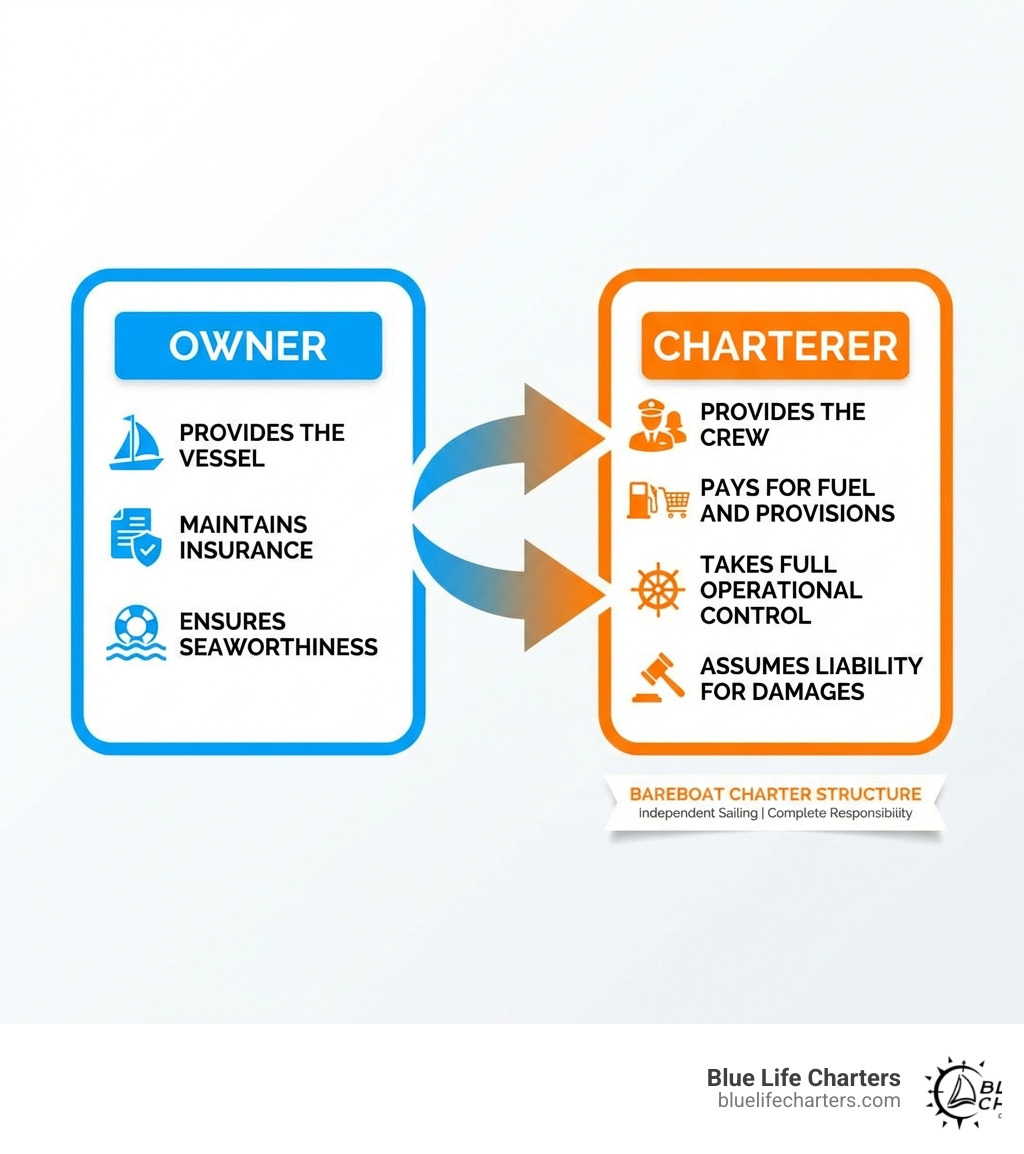
A bareboat charter agreement is a legal contract where a vessel owner leases their boat to you without providing a crew. You take full possession, command, and control of the vessel, becoming the temporary “owner” for the charter period. This means you’re responsible for crewing, navigation, fuel, provisions, and all operational decisions.
Key Components of a Bareboat Charter Agreement:
- Parties & Vessel – Names of owner and charterer, plus boat specifications
- Charter Period – Exact start/end dates, delivery/redelivery locations
- Fees & Deposits – Rental amount, payment schedule, security deposit terms
- Responsibilities – Charterer handles all operations, owner provides seaworthy vessel
- Insurance & Liability – Coverage requirements, damage responsibilities
- Restrictions – Navigation limits, prohibited activities, crew qualifications
- Cancellation Policy – Refund terms, notice periods, force majeure conditions
The global bareboat charter market was valued at $11.5 billion in 2022 and is projected to reach $18.2 billion by 2030, growing at 5.9% annually. This growth reflects increasing demand from individuals and companies who want vessel access without full ownership commitment.
Unlike a crewed charter where the owner provides captain and crew, a bareboat charter transfers complete operational control to you. Think of it as the difference between renting a car versus hiring a chauffeur-driven limousine. The vessel becomes yours to command for the agreed period, but with that freedom comes significant responsibility.
Understanding your bareboat charter agreement is crucial before you sign. This contract determines who pays for what, who’s liable if something breaks, and what happens if you need to cancel. The terms can vary significantly between charter companies and jurisdictions, so reading the fine print isn’t optional—it’s essential.
Dissecting the Bareboat Charter Agreement: Key Clauses and Components
A bareboat charter agreement is more than just a piece of paper; it’s the blueprint for your independent sailing adventure. This legally binding document defines the relationship between you, the charterer, and the vessel owner, outlining every detail from the moment you take possession to when you return the boat. A well-drafted agreement protects both parties, ensuring clarity and minimizing misunderstandings. While many agreements exist, standard forms like those from BIMCO provide comprehensive frameworks. We encourage you to review a View Sample contractSample contract in SmartConView to familiarize yourself with the typical structure.
The essential clauses found in a typical bareboat charter agreement cover a wide range of topics:
- Identification of Parties and Vessel: Clearly states who is involved and what boat is being chartered.
- Charter Period: Defines the exact dates and times the charter begins and ends.
- Delivery and Redelivery: Specifies the condition of the vessel at handover and return.
- Charter Hire & Payments: Outlines the rental fees, payment schedule, and any additional costs.
- Security Deposit: Details the amount, purpose, and refund process for the deposit.
- Operational Responsibilities: Assigns duties for crewing, maintenance, and navigation.
- Navigation Limits: Sets the geographical boundaries for vessel operation.
- Insurance & Liability: Clarifies coverage, deductibles, and responsibility for damages.
- Prohibited Uses: Lists activities not permitted on the vessel.
- Cancellation Policy: Explains the terms for cancelling the charter and associated refunds or fees.
- Dispute Resolution: Defines how conflicts will be handled.
Let’s explore some of these critical components.
The Parties and the Vessel
At the heart of every bareboat charter agreement are the parties involved: the owner and the charterer. The agreement will clearly state the full legal names and contact information for both. Equally important are the detailed specifications of the vessel itself. This includes the yacht’s name, type (e.g., sailboat, catamaran, motor yacht), length, make, model, and official registration number. Sometimes, additional details like the vessel’s capacity (e.g., maximum 6 guests on our sailing yachts) or specific onboard features are also listed. This ensures everyone is on the same page about which beautiful boat you’ll be commanding!
Want to know more about the kind of vessels we offer for an unforgettable experience in Charleston? More info about our fleet.
Charter Period, Fees, and Security Deposit
This section is all about the “when” and the “how much.” The bareboat charter agreement will precisely define the term of charter, including the exact start date and time for delivery, and the end date and time for redelivery. For instance, a typical agreement might specify a delivery at 9:00 AM on Monday and redelivery by 5:00 PM on Friday. It will also outline the conditions for both delivery and redelivery—for example, that the vessel must be returned in a clean state, free of indebtedness, and with all equipment aboard.
The charter hire, or rental fee, will be clearly stated, along with a payment schedule. This often includes an initial deposit to secure your booking, with the full balance due a certain number of days (e.g., 30 or 45 days) prior to the charter start date. Be aware of late fees if payments aren’t made on time.
A crucial financial component is the security deposit. This is a refundable amount held by the owner to cover potential late return charges, damages not covered by insurance, repair costs within the insurance deductible, or unpaid consumable items like fuel. The agreement will detail the specific amount (e.g., $1000 or more, depending on the vessel size), what it can be used for, and the process and timeline for its refund after a satisfactory inspection of the vessel upon redelivery. We want your return to be as smooth as your sail, so understanding this is key!
Operational and Use Clauses
These clauses define the boundaries and expectations for how you’ll operate your chartered vessel. Navigation limits are a common restriction, often tied directly to the yacht’s insurance policy. This might mean cruising is restricted to coastal and inland waters, potentially with specified distances offshore. For instance, in Charleston, your agreement might specify operating within the harbor and nearby intercoastal waterways, and not venturing far offshore. Operating outside these limits could void your insurance and make you fully liable for any incidents.
The agreement will also state the restricted use of the vessel, typically stipulating it’s for pleasure only and not for commercial trade or illegal activities. This includes a strict prohibition of illegal activities such as smuggling or carrying illicit substances. Violating these terms can lead to immediate termination of the charter, forfeiture of all funds, and even legal consequences, including potential forfeiture of the vessel itself.
Furthermore, sub-charter restrictions are almost always in place, meaning you cannot re-rent the vessel to someone else without the owner’s explicit written consent. Your bareboat charter agreement is personal to you.
Finally, crew competency requirements are paramount. As the charterer, you are the captain, and you must possess sufficient experience, knowledge of seamanship, piloting, and the “Rules of the Road.” The owner often reserves the right to assess your competency and may require you to hire a professional instructional skipper at your expense if your skills are deemed insufficient. Safety first, always!
Roles and Responsibilities: Who Does What?
In a bareboat charter agreement, the division of roles is clear: we provide the vessel, and you take the helm, both literally and figuratively. This means a significant transfer of responsibility and operational control. It’s an exciting prospect, offering unparalleled freedom, but it also means understanding who is accountable for what. While we ensure the vessel is ready for your adventure, your role as charterer means you’re essentially the temporary owner, making all operational decisions and bearing the associated responsibilities. This clear division helps manage potential risks and liabilities for both parties, ensuring a smooth and enjoyable experience on the water.

Understanding Your Bareboat Charter Agreement Responsibilities as the Charterer
As the charterer, you assume full operational control of the vessel. This means you are responsible for crewing and provisions. You decide who is on board (up to the vessel’s capacity, of course!), and you ensure everyone is fed and comfortable.
You’re also responsible for all running expenses during the charter term. Think of it like renting a car – you pay for the gas! On a boat, this includes fuel, water, dockage, pilotage fees, port charges, and any other consumable stores. When you return the vessel, it’s typically expected to be refueled and cleaned.
Routine maintenance and minor repairs fall under your purview. If something simple needs attention, like a clogged head or a loose fitting, it’s your responsibility to address it or notify us promptly if it requires professional help. However, you’ll need our authorization for any significant repairs.
Crucially, you bear liability for damages and insurance deductibles. While we maintain primary insurance coverage on the vessel, you are responsible for any injury to the yacht, its equipment, or furnishings caused by you or your party. This includes the deductible amount of our insurance policy and any loss or damage not covered by insurance, especially if due to your negligence or failure to comply with the agreement. For instance, if you accidentally ground the vessel, you’ll be responsible for the fair market costs of the repairs, potentially exceeding your security deposit.
You step into the shoes of the owner for the duration of your charter, making all operational decisions and accepting the associated risks. But don’t worry, we’re always here to offer support and guidance should you need it.
Ready to take command? Learn more about More info on our bareboat charters.
The Owner’s Obligations
While you’re enjoying the freedom of the open water, we, as the owner, have essential obligations outlined in the bareboat charter agreement to ensure your trip is safe and enjoyable. Our primary responsibility is delivering a seaworthy and fully commissioned vessel. This means the yacht will be in good working order, clean, properly outfitted, and compliant with all safety regulations when you take possession. We ensure all necessary safety equipment, like PFDs, fire extinguishers, and a VHF radio, are onboard and functioning.
We are also responsible for maintaining the vessel’s primary insurance, typically covering Hull & Machinery (H&M) for physical damage to the boat and Protection & Indemnity (P&I) for third-party liabilities. This coverage protects our investment and offers a layer of security. However, your liability as the charterer for damages often extends to the deductible amount of our policy.
Furthermore, we ensure the structural integrity of the vessel and that it meets all classification requirements. We guarantee a clear title to the vessel, meaning there are no hidden claims or liens that could disrupt your charter. While you handle the day-to-day operations, we stand behind the quality and readiness of our fleet, ready to assist if unforeseen issues arise (not caused by you, of course!).
At Blue Life Charters, we pride ourselves on the meticulous care and management of our yachts, ensuring they are always in prime condition for your adventures in Charleston. More info on yacht management.
Bareboat vs. Other Charters: What’s the Difference?
Understanding the nuances between different types of charter agreements is key to choosing the right experience for your needs. While the bareboat charter agreement offers ultimate independence, other options exist. Let’s compare them:
| Aspect | Bareboat Charter | Time Charter | Voyage Charter |
|---|---|---|---|
| Possession & Control | Charterer has full possession and control. | Owner retains possession and control. | Owner retains possession and control. |
| Crewing | Charterer provides and pays for the crew. | Owner provides and pays for the crew. | Owner provides and pays for the crew. |
| Operational Expenses | Charterer pays all operating costs (fuel, port fees, provisions). | Charterer pays variable costs (fuel, port fees), owner pays fixed costs (crew wages, insurance). | Owner pays all operating costs. |
| Purpose | Lease of the vessel for a period, charterer operates. | Charterer directs vessel’s movements for a fixed period. | Transport specific cargo between fixed ports. |
| Risk | Higher operational risk for charterer. | Shared operational risk. | Higher operational risk for owner. |
Bareboat Charter
As we’ve explored, a bareboat charter agreement is essentially a lease of the vessel. You, the charterer, gain possession and control, becoming responsible for every aspect of its operation. This includes providing the crew (which could just be you and your competent friends!) and paying all expenses like fuel, water, food, and dockage. It’s the most immersive and independent way to experience the water, perfect for experienced sailors who want to chart their own course.
Time Charter
A time charter is a step up from bareboat in terms of provided services. Here, the owner retains possession and provides the crew, who are employees of the owner. The owner also pays for vessel operating costs like crew wages, insurance, and maintenance. However, the charterer directs where the vessel goes and for what purpose, within agreed limits, for a fixed period. The charterer typically pays for variable costs like fuel and port fees. This is common for commercial shipping where a company needs a vessel for a specific duration but doesn’t want to manage the crew or long-term maintenance.
Voyage Charter
The voyage charter is even more hands-off for the charterer. In this scenario, the owner retains possession and provides the crew, and the contract is specifically to carry specific cargo for a single voyage between two ports. The charterer pays a freight fee, and the owner is responsible for virtually all operational costs, including fuel, crew, and port fees. This is almost exclusively a commercial arrangement, typically used for transporting goods from point A to point B.
The Fine Print: Legal, Insurance, and Contingency Planning
Navigating a bareboat charter agreement isn’t just about understanding the boat; it’s also about understanding the legal and financial waters you’re sailing in. The fine print of these agreements is where the commitments, protections, and potential pitfalls reside. It’s crucial to approach this section with a magnifying glass, ensuring you comprehend every clause and its implications. This diligence ensures your Charleston adventure is as smooth legally as it is on the water.
Legal Waters: Navigating Your Bareboat Charter Agreement
Every bareboat charter agreement will specify its governing law and jurisdiction. For charters originating in Charleston, SC, this typically means the agreement will be interpreted and enforced under the laws of South Carolina, and often, Federal Maritime Law. This dictates which legal system would hear any disputes.
Speaking of disputes, the agreement usually outlines the dispute resolution process, often preferring arbitration over litigation. Arbitration, as facilitated by organizations like the American Arbitration Association (AAA) website, provides a structured, often faster, and more private way to resolve conflicts outside of traditional court proceedings. It’s a common clause designed to efficiently handle any disagreements that might arise.
You’ll also find clauses related to indemnification and liens. You, as the charterer, will typically agree to indemnify the owner, meaning you’ll protect them from liabilities to third parties caused by your negligence. Furthermore, the agreement will explicitly state that you cannot permit any maritime liens to be created against the vessel, reinforcing that the boat remains the owner’s property, despite your temporary command.
Insurance, Damage, and Breakdowns
When it comes to your bareboat charter agreement, insurance is a critical safety net. We, as the owner, provide owner’s insurance coverage for the vessel, which typically includes Hull & Machinery and Protection & Indemnity. However, it’s vital to understand your charterer’s liability for loss or damage. You are generally responsible for damages caused by your party, up to the deductible amount of our insurance policy. Some agreements may offer an optional Damage Waiver (DW) to mitigate this risk, but it’s crucial to know what it covers and, more importantly, what it doesn’t. Negligent misuse, fines, and operating under the influence are almost never covered.
So, what happens in case of breakdown? If the vessel is disabled due to a major system failure not caused by your actions for an extended period (e.g., more than 48 consecutive hours), the agreement typically provides for a pro-rata return of your rent for the unused time. If the breakdown is due to an “act of God” (like a natural calamity), we might endeavor to provide a suitable replacement yacht. However, if the breakdown is due to your fault or negligence, you could be liable for repair costs and even loss of income for the owner if the vessel cannot be chartered subsequently.
The role of the security deposit here is paramount. It serves as a financial safeguard for us against damages, missing equipment, or cleaning fees upon redelivery. If you return the boat in pristine condition, the deposit is fully refunded. However, if there are damages or other charges, they will be deducted from this deposit. We want you to focus on enjoying the beautiful Charleston waters, so understanding these provisions beforehand can prevent any unwelcome surprises.
For more clarity on these and other operational questions, be sure to check out our Find answers in our FAQs.
Cancellation Policies
Life happens, and sometimes plans change. That’s why understanding the cancellation policies in your bareboat charter agreement is so important. These policies are designed to balance the charterer’s need for flexibility with the owner’s need to cover costs and potential lost revenue.
Typical cancellation terms often involve a tiered refund structure. For example, if you cancel far in advance (e.g., more than 30 or 90 days before departure), you might receive a full refund minus a small administrative fee. As you get closer to the charter date, the refund percentage typically decreases. Cancellations made very close to the departure date (e.g., within 24 hours) often result in a complete forfeiture of funds.
For instance, some Charleston charter agreements specify a 50% refund if you cancel within 7 days, and no refund if you cancel within 24 hours. However, some companies offer gift cards for future charters if cancellations within 7 days are due to health reasons or national emergencies like a pandemic.
What about us, the owner? If we have to cancel due to severe weather, environmental conditions, unforeseen prohibitive events, or mechanical failure (not your fault!), we will typically offer to reschedule your charter or provide a full refund. “Severe weather” is almost always at the captain’s sole discretion, prioritizing safety above all else. These clauses, often referred to as force majeure, cover unforeseen circumstances beyond anyone’s control. Always review the specific cancellation terms in your agreement carefully!
Frequently Asked Questions about Bareboat Charter Agreements
We know you’ll have questions when considering taking the helm. Here are some common inquiries about bareboat charter agreements to help you prepare for your Charleston adventure:
What qualifications do I need for a bareboat charter?
To start on a bareboat charter, you typically need to demonstrate sufficient experience and competence in handling a vessel of similar type and size. This often involves submitting a sailing resume detailing your boating history, certifications (like ASA or US Sailing certifications), and experience with navigation, docking, and emergency procedures. We, as the owner, reserve the right to assess your competency. If your experience is deemed insufficient, we might require you to hire a professional instructional skipper at your expense. Furthermore, many states, including South Carolina, have boating safety education requirements for operating certain vessels, especially for younger operators. For example, in South Carolina, anyone born after July 1, 1983, must complete a boating safety course to operate a boat with a 15-horsepower engine or greater.
What happens if the yacht is damaged during my charter?
In the unfortunate event of damage to the yacht during your charter, your bareboat charter agreement will clearly outline the process. As the charterer, you are responsible for any injury to the yacht, its equipment, or furnishings caused by you or your party. This typically includes liability up to the deductible amount of our insurance policy. You must notify us immediately of any accident, malfunction, or breakdown. Unauthorized repairs are usually prohibited, so always contact us first. The cost of repairs, based on materials and labor, will likely be deducted from your security deposit. If the damage is extensive or due to gross negligence, your liability could exceed the security deposit. Returning the yacht in the same condition as received (normal wear and tear excepted) is a key expectation.
Are there geographical limits on where I can take the boat?
Yes, almost every bareboat charter agreement includes geographical limits on where you can operate the vessel. These navigation limits are often determined by the yacht’s insurance policy and are crucial for managing risk. For charters out of Charleston, this typically means cruising is restricted to coastal and inland waters, such as the Charleston Harbor, the Intracoastal Waterway, and nearby protected areas. There will likely be restrictions on how far offshore you can venture (e.g., a maximum of a few miles). Operating outside these specified limits can void your insurance coverage, making you fully liable for any incidents or damages. Always review and adhere to these limits to ensure a safe and insured journey.
Conclusion: Setting Sail with Confidence
The bareboat charter agreement is your compass to independent sailing. It’s a comprehensive document that, once understood, empowers you with the freedom of the open water while clearly defining the responsibilities of both parties. A clear contract protects everyone involved, ensuring that your adventure is not only thrilling but also legally sound and worry-free. From understanding your duties as the temporary captain to knowing our obligations as the owner, every clause works to ensure a smooth and successful charter experience.
At Blue Life Charters, we believe in transparent agreements and unforgettable moments. We’re here to help you understand every aspect of your bareboat charter agreement so you can cast off with confidence and create cherished memories on the beautiful waters of Charleston and Folly Beach, SC.
Ready to take command of your own Charleston adventure? Explore our Bareboat Charter options and let’s get you on the water!